Bill
9-13-17
http://www.salon.com/2017/01/15/the-art-of-learning-why-art-history-might-be-the-most-important-subject-you-could-study-today/
By juxtaposing and discussing John Berger's Ways of Seeing and other's points of view, the author has made the statement clearly that art history is essential to be in the school curriculum; art history, as in the humanities, teaches students how to learn by offering them the interdisciplinary connections and the process of human development, through which people get the sense of how human culturally have been changing by degrees and how might human keep up the progress in the near future. Humanities including art histories are established upon the civilization; it communicates the process of its formation, guiding human with more possibility of not only technically solving problem but also having a right mentality to solve the problem and to develop in the future.
We study art history sometimes in different ways, and one thing that has been usually neglected by us when learning it is we look at the past through our own lens. Enforcing today's technology and mentality onto the culture, the art from a couple hundred or even thousands year ago changes every thing: the original condition, the intentions, the thoughts throughout making the work. I agree with the point of view that the art history helps us pay attention to what we are and what we should learn, as well as in what way we learn.
What STEM subjects provide is, I would say, as important as what art history provide, that is to offer the connections all over the subject field; one of the most important things benefit the entire civilization is to listen and accept the different perspectives, to "think outside of the box". In that way we look art history upon as an eye opener to improve adaptability and build the right mentality through studying.
Wednesday, September 13, 2017

Thursday, May 25, 2017
About me.
Bill
Majority of my work this year concentrate on the exploration of different materials apart from ink drawing. I found Photoshop might be a interesting media to combine the photography and the ink drawing of mine in the beginning of the year, consequently I pushed myself into the area of digital art; Meanwhile, I started to experiment with the fuji film camera I own to practice my photography technique. What photography brings me is a different and unique perspective of life. Inspiration comes through the lens is not only from everyday life but also originated in my mind; inspiration's born in the creativity, and camera functions as the recorder. Initially, I tried different set-up in my room without tripod and professional lighting; I shot a photo, put it into Photoshop and played around with it, which, I firmly believe, was a great experience for me. I was motivated to continue exploring on the field of digital and on the combination of my photography and my line drawing. Some of my work (mostly including photography and digital collages finished later in this school year) are displayed below.


Majority of my work this year concentrate on the exploration of different materials apart from ink drawing. I found Photoshop might be a interesting media to combine the photography and the ink drawing of mine in the beginning of the year, consequently I pushed myself into the area of digital art; Meanwhile, I started to experiment with the fuji film camera I own to practice my photography technique. What photography brings me is a different and unique perspective of life. Inspiration comes through the lens is not only from everyday life but also originated in my mind; inspiration's born in the creativity, and camera functions as the recorder. Initially, I tried different set-up in my room without tripod and professional lighting; I shot a photo, put it into Photoshop and played around with it, which, I firmly believe, was a great experience for me. I was motivated to continue exploring on the field of digital and on the combination of my photography and my line drawing. Some of my work (mostly including photography and digital collages finished later in this school year) are displayed below.


Zipporah Thompson
Bill
The visual artist Zipporah Thompson has a bachelor of Fine Arts in University of North Carolina at Charlotte. Her exploration of death, chaos or catastrophe is deeply reflected in her mix-media work, in which she skillfully utilizes different media like frame or board to express her concept of dream and celestial landscape.
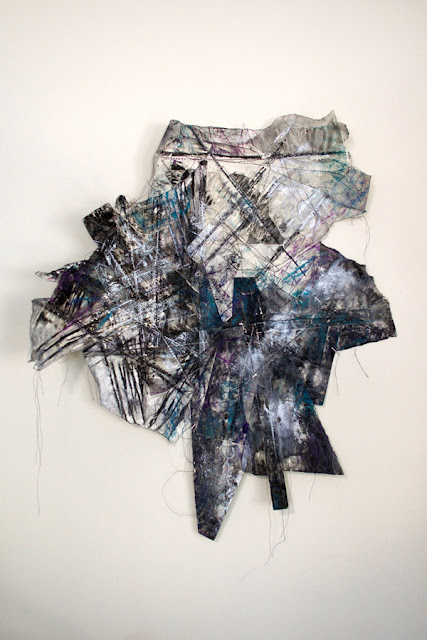


The visual artist Zipporah Thompson has a bachelor of Fine Arts in University of North Carolina at Charlotte. Her exploration of death, chaos or catastrophe is deeply reflected in her mix-media work, in which she skillfully utilizes different media like frame or board to express her concept of dream and celestial landscape.
 |


Her pieces are composed of objects in various geologic forms which are sort of distorted, thoroughly conveying a perspective of chaos and depicts the metamorphosed celestial typography.
Tommy Tylor
Bill
The Tennessee-based artist Tommy Taylor devotes himself to the public reflection through his art and his books and has been committed to the area of art education. As an emerging artist, he traveled through Europe and Asia while he continued to develop his work in Goldsmith University. Taylor's back to the monochromatic line drawing in which the composition and texture are pretty much simplified but greatly emphasized. He centers on the art state in which elements are refined. He has a relatively tough quality in his handling which pushes his line drawings to a certain level of visual impact.


Some of his work has a architectonic sense. The lines seems are unintentionally connected by the artist and the monochromatic background bring some interesting texture to his work.


The Tennessee-based artist Tommy Taylor devotes himself to the public reflection through his art and his books and has been committed to the area of art education. As an emerging artist, he traveled through Europe and Asia while he continued to develop his work in Goldsmith University. Taylor's back to the monochromatic line drawing in which the composition and texture are pretty much simplified but greatly emphasized. He centers on the art state in which elements are refined. He has a relatively tough quality in his handling which pushes his line drawings to a certain level of visual impact.


Some of his work has a architectonic sense. The lines seems are unintentionally connected by the artist and the monochromatic background bring some interesting texture to his work.

Tuesday, May 23, 2017
Ann Stewart
Bill Wu
Atlanta artist Ann Stewart concentrates on geometric patterns as well as architectural elements in her unique art pieces; her delicate handling initially depicts the construction in real world, but starts to apply different quality and principles in her work later on: she manages structures, duplicates them into the form of Mandela which makes them come alive. The way she express the real world construction embodies emotional, illogical world.
 Proper Breakdown
 Anamorphic Loop
18.75 x 18.75 inches
Atlanta artist Ann Stewart concentrates on geometric patterns as well as architectural elements in her unique art pieces; her delicate handling initially depicts the construction in real world, but starts to apply different quality and principles in her work later on: she manages structures, duplicates them into the form of Mandela which makes them come alive. The way she express the real world construction embodies emotional, illogical world.
39.25 x 37.25 inches
Ann Stewart
Ann Stewart
18.75 x 18.75 inches
Ann Stewart
 Epicenter
12 x 12 inches


12 x 12 inches
Ann Stewart
Here's also a couple of sculptures from Ann Stewart.
There are certainly some chaotic feelings and sense of struggling communicated here through those wiggled lines movement and such a variety of geometric shape.
Eric Mack
Bill Wu
Eric Mack who graduated from Atlanta College of Art in 1998 is a artist who is noted for his painting. With discovering primary beauty from everyday life, he transforms them into various shape, form and pattern and reorganize them for his art work. Some of his pieces have a certain quality of architecture; his using of structure and composition provides a variety for the content of his pieces.


Eric Mack who graduated from Atlanta College of Art in 1998 is a artist who is noted for his painting. With discovering primary beauty from everyday life, he transforms them into various shape, form and pattern and reorganize them for his art work. Some of his pieces have a certain quality of architecture; his using of structure and composition provides a variety for the content of his pieces.
Blocks are interconnected with each other through broken lines and colors with dripping quality and the space left at the center split the piece meanwhile provides a focal point to some degree. The composition is very interesting to look at.
Sunday, April 23, 2017
Ruan Hoffmann
Bill
Ruan Hoffmann's artwork gives a fresh eye on mix media. He graduates from South Africa and becomes a full-time artist who works with several mediums. Hoffmann has a highly distinguished style of transforming an unshaped, plain clay chunk into a piece of art by using photography, drawing, painting, type or metallics. The most impressive part is also the most indispensable part of the work to me is the base he uses for his art--ceramic. His pieces teem with a rich amount of mediums--it all depends on how would the artist arrange them.

 No need too much interpreting toward his works because I think they are all kind of self-explanatory; It's never a well-planned, conscious process of creating art, those contents floating in pieces pretty much express Hoffmann himself as an artist.


Ruan Hoffmann's artwork gives a fresh eye on mix media. He graduates from South Africa and becomes a full-time artist who works with several mediums. Hoffmann has a highly distinguished style of transforming an unshaped, plain clay chunk into a piece of art by using photography, drawing, painting, type or metallics. The most impressive part is also the most indispensable part of the work to me is the base he uses for his art--ceramic. His pieces teem with a rich amount of mediums--it all depends on how would the artist arrange them.


Subscribe to:
Posts (Atom)